
ZIP 33030
Downtown and west Homestead
Downtown Homestead, historic district near Krome Avenue
See ZIP 33030Gutter guard cleaning means cleaning the guard or screen on top of your gutter and clearing the trough underneath it. Guards stop leaves. Pollen, seed pods, and roof grit pile on top or slip through, so most guards still clog. Fast Pro cleans the guard, clears the trough, and flushes the downspouts.
Serving Homestead, FL homeowners. 6+ years of experience. 450+ jobs completed. Last updated .

Every guard cleaning includes
Free inspectionGuards stop whole leaves and fronds. Mango blossoms, bits of fruit, grit and palm fiber still collect on top of them or underneath, so we brush the guard, clear the trough below, flush the downspouts and set the guard back flat.
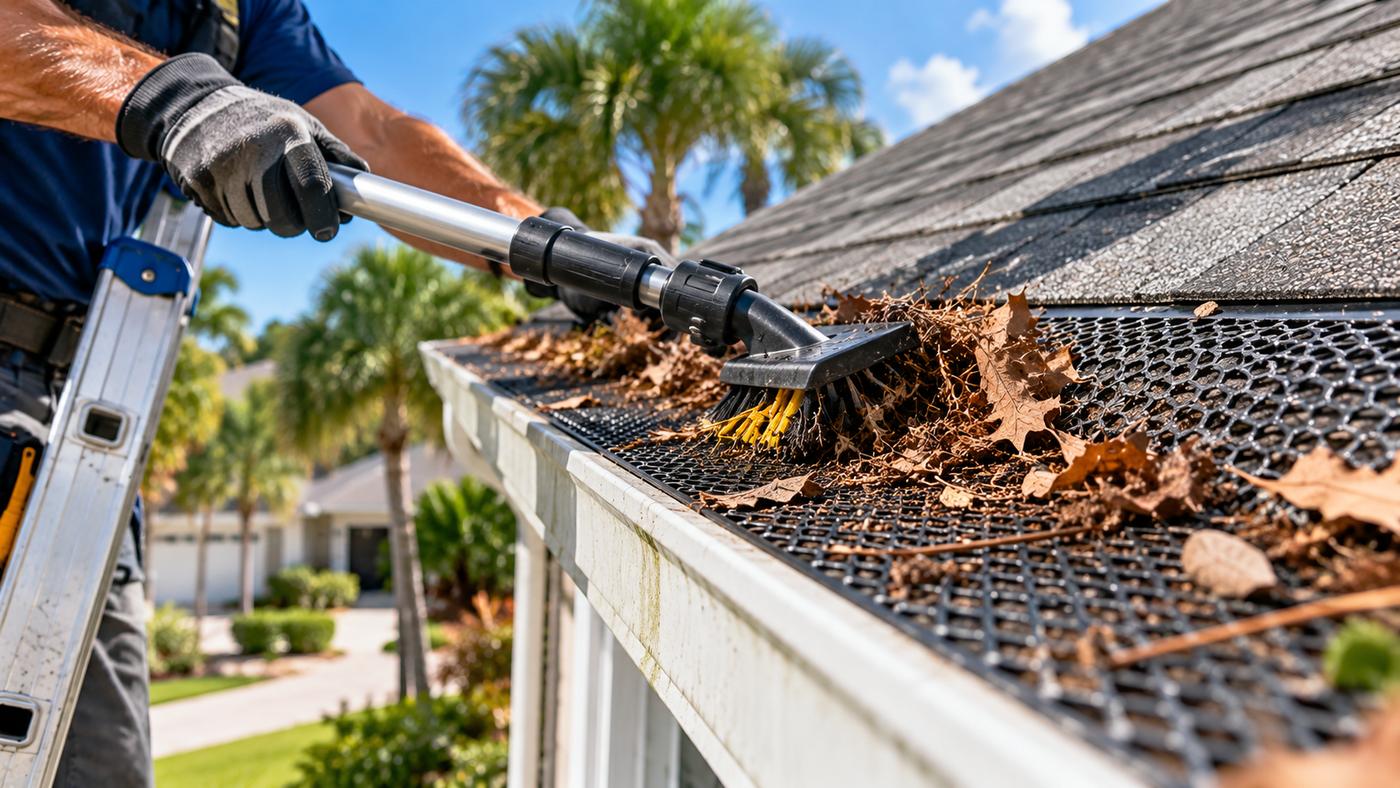
Guards cut the large debris, and Homestead has plenty of it: mango and avocado leaves, lychee and longan leaves, whole palm fronds. They do not stop the small stuff. Blossoms, bits of fruit, tile grit and fine dust settle on the surface or work through the openings, and palm fiber catches along the top edge and mats down.
A matted guard sends water over the front edge instead of through it. In a month like August, which averages 10.17 inches of rain, that overflow lands on the walkway or the wall. Fine mesh films over faster in the dry months, when field dust and pollen are in the air.
Each guard type gets its own method. We lift what lifts without bending the frame, brush and rinse the guard, clear the trough underneath by hand, flush the downspouts and set the guard back flat. Guards screwed down or tucked under the roofing are cleaned from the top, and we flush the trough through the openings.
If a guard is bent, cracked or packed solid, we tell you before you pay for a cleaning that will not hold. Foam inserts that have sprouted seeds are the usual example. A house under fruit trees needs its guards cleaned more often than one on an open lot, and the visit before May 15 matters most.
Yes. Guards change what lands in the trough and how often you have to deal with it. They do not end the job.
A guard works like a lid. It keeps big debris out, and water has to pass through or around it. Whatever the lid cannot pass stays on top, and whatever it lets through settles underneath. Pollen, seed pods, and roof grit are the usual culprits.
| Guard type | Blocks well | What gets through or piles up | How we clean it |
|---|---|---|---|
| Micro-mesh | Needles, seed pods, most roof grit | Wet pollen can film the surface and slow the water | Brushed and rinsed on top, trough flushed through the mesh or from the end |
| Screen or perforated | Large leaves | Needles, pollen, and grit pass through and settle underneath | Lifted where possible, cleaned, trough cleared by hand |
| Reverse-curve (surface tension) | Leaves and large debris | Fine debris can collect at the nose opening | Opening cleared and rinsed, trough checked and flushed |
| Foam inserts | Large debris, at first | Seeds sprout in the foam and debris embeds in the pores | Pulled and rinsed, or replaced if clogged through |
| Brush inserts | Large debris | Debris tangles in the bristles and holds water | Pulled out and shaken clean, trough cleared by hand |
We clean the guards that are already on your house. If you are weighing guards for a house that has none, tell us what falls on your roof first. The right guard depends on it. The gutter cleaning page lists what we pull out of an unguarded trough.
The steps change with the guard, so we start by finding out how yours is attached.
We look at the type, the material, and how it attaches. Some guards slide out, some hinge up, some are screwed down, and some tuck under the first row of roofing.
Sections that come up cleanly get lifted and set aside. We do not force a guard that is screwed or tucked, because bent frames leave gaps where debris gets in.
Surface debris comes off with a soft brush, and the guard is rinsed on both sides so the openings are clear.
This is where the pollen paste, seed pods, and roof grit have collected. We scoop it out and bag it, the same as on an unguarded gutter.
Water runs through each run and each downspout until the flow is steady. A guard does not stop a blockage at the elbow.
Each guard goes back flat against the roof edge and the gutter lip. A gap or a lifted corner lets debris in on the next storm.
You see the guard and the trough before and after, plus a plain note on any bent, cracked, or missing sections.
Pollen and fine debris sit on top of the guard, so we clean the surface before we reach the trough.
The same section of gutter, photographed from the same spot before and after.
Pick your ZIP code to see the neighborhoods we cover, or call and we will confirm your street.
Downtown and west Homestead
Downtown Homestead, historic district near Krome Avenue
See ZIP 33030Redland
Redland
See ZIP 33031Leisure City and Naranja
Leisure City, Naranja, Naranja Lakes
See ZIP 33033North Homestead, Princeton and Naranja
Princeton, Naranja, north Homestead
See ZIP 33032South Homestead and the Florida City line
South Homestead, Florida City
See ZIP 33034Southeast Homestead and Florida City
Southeast Homestead, Florida City
See ZIP 33035Not sure we cover your ZIP code? Call us at (813) 856-2726.
The price depends on the feet of gutter, the number of stories, how packed the runs are and whether guards are installed. Homestead homes range from short runs over a front door to gutters around the full roofline. Call with your ZIP code and we quote by phone.
It depends on the roof size, the material, the pitch and how much algae is on it. A one-story concrete tile roof, a metal roof on a farmhouse and a two-story shingle roof are different jobs. Tell us the roof type and the stories and we quote by phone.
Early May, before rain climbs from 2.9 inches in April to 5.8 inches in May. A second visit between mid-October and December clears what hurricane season left. Homes under mango or avocado trees may need a third look in late summer.
Every two to three years suits most roofs. Slopes under trees go dark sooner.
Yes. After a named storm we move cleanups up the schedule, clear fronds, branches and leaf mats from the roof and the trough, and flush every downspout.
We clean houses and their roofs, including homes on large Redland lots. Packing houses, greenhouses and other commercial buildings are outside our work.
Pressure is the risk. Tile care guides cap cleaning pressure near 1,200 psi and warn that some cleaners etch concrete. On tile we soft wash with a compatible cleaner. On metal we keep pressure low and avoid scuffing the coating.
They stop whole leaves. Blossoms, fruit pieces and fine debris still collect, so guards under fruit trees need regular cleaning.
Once a year at minimum and twice under trees. If you can book only one visit, make it early May.
Look for water sheeting over the front edge during a storm, or seedlings growing in the guard. Both mean the surface is matted.
Call and tell us what guard you have and what you see on top. We quote by phone and find a day that works.
Call (813) 856-2726